Bank of Russia Ordinance No. 7441-U on the RUB 300,000 limit and the BTC, ETH and USDT list
Contents7 sections
Bank of Russia Ordinance No. 7441-U of 11 September 2026 has applied since 17 November 2026. The limit for a non-qualified resident acquiring digital currency through one intermediary is RUB 300,000 per calendar year. The ordinance sets out how to calculate the limit. The ordinance identifies Bitcoin (BTC), Ether (ETH) and the foreign digital instrument USD Tether (USDT) as eligible for admission to public trading on organised markets. The Russian Ministry of Justice registered the ordinance on 30 October 2026 under No. 88991, and it was officially published on 6 November. Under paragraph 9, the ordinance takes effect after the expiry of 10 days following its publication. [1] [2]

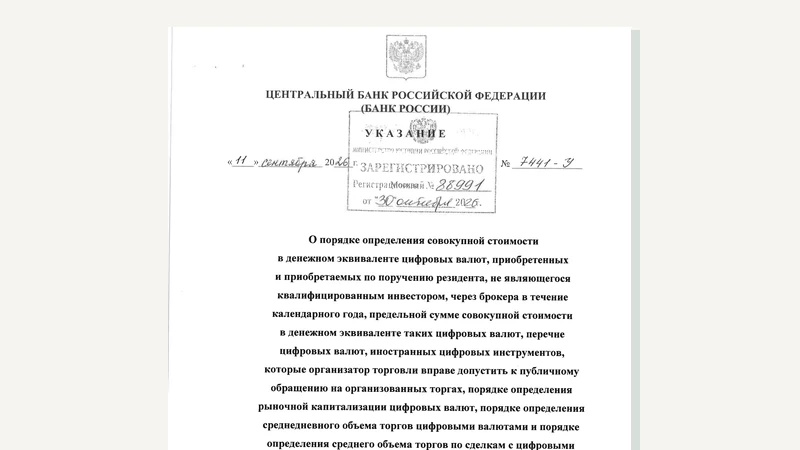
The ordinance was adopted under Federal Law No. 282-FZ “On Digital Currencies and Digital Rights”. When a broker buys digital currency on the instruction of a non-qualified resident, whether an individual or a legal entity, the law requires it to check the limit and the admission of the currency to public circulation (paragraphs 3 and 4 of part 1 of Article 31). The law left the amount of the limit, the calculation procedure and the list of currencies to the Bank of Russia. [3] [4]
Limit calculation · Trading and testing status · Intermediary checklist. The buyer’s guide with a 5 November status check gives further details on the purchase process.
Provisions of Ordinance No. 7441-U
The preamble names three grounds in Law No. 282-FZ. Part 4 of Article 1 extends the requirements for digital currencies to foreign digital instruments. Paragraph 3 of part 1 of Article 31 establishes the limit condition, and part 13 of Article 31 sets the inclusion criteria and directs the Bank of Russia to establish the list. [1] [4]
| Paragraph | What it establishes | Who it concerns |
|---|---|---|
| 1 | Sum of the rouble acquisition values of earlier purchases and the assets in the new order through the same broker in the calendar year | Brokers and, in the cases covered by part 3 of Article 31, exchange organisations, clearing organisations and trust managers |
| 2 | Limit amount of RUB 300,000 | The same intermediaries |
| 3 | The list of digital currencies for public circulation includes BTC and ETH with assigned identification codes | Trading organisers |
| 4 | Market capitalisation according to a foreign trading organiser equals the closing price multiplied by the number of units in circulation, for a calendar day on which trading took place | The Bank of Russia when including currencies in the list |
| 5 | Average daily trading volume as the arithmetic mean over the trading days on the foreign venue | The Bank of Russia when including currencies in the list |
| 6 | Arithmetic mean of the foreign venue’s total trading volume in digital currency transactions over the two calendar years before the year of inclusion | The Bank of Russia when including currencies in the list |
| 7 | Paragraphs 1, 2 and 4–6 also apply to foreign digital instruments | Intermediaries when calculating the limit and the Bank of Russia when calculating the metrics |
| 8 | The list includes the foreign digital instrument USDT | Trading organisers |
| 9 | Entry into force after the expiry of 10 days following official publication | Everyone |
Paragraph 1 describes the broker’s calculation. Part 3 of Article 31 extends the rules for both non-qualified and qualified residents to purchases from exchange organisations (registered crypto exchange providers) and clearing organisations, purchases by trust managers managing the resident’s property, and the specified loans with brokers, exchange organisations, clearing organisations or trust managers. Parts 1–3 of Article 31 do not apply to transactions or operations for payment, counter-performance or another arrangement implying payment under a foreign trade contract, or to those for concluding, performing or terminating the contract or securing performance of its obligations. Part 8 of Article 1 also covers a resident providing the relevant services to a party as an agent, commission agent or mandatary. [4]
The RUB 300,000 limit
To apply the limit, establish residency under Law No. 173-FZ, the type of client and the scope of any qualified investor status. A qualified resident must read the risk notice. A qualified individual must also pass the test (part 2 of Article 31). The Bank of Russia clarified that recognition before 1 September 2026 as a qualified investor for all types of transactions reserved for qualified investors also covers transactions in digital currencies (question 15). [4] [5]

Each intermediary calculates the limit separately for the calendar year. The calculation includes earlier acquisitions and the value of the new order. Selling an asset does not replenish the limit. The Bank of Russia confirmed the cumulative calculation in question 14 and the application of the limit to a contract of exchange (barter) in question 8. [1] [5] [6]
How to calculate the remaining limit
One broker, calendar year 2027
- FebruaryThe client bought RUB 120,000 of BTC, leaving RUB 180,000 of the RUB 300,000 limit.
- MayThe client sold the BTC. The remaining limit was still RUB 180,000.
- SeptemberThe client placed an order for RUB 200,000 of ETH. Including the order would bring the total to RUB 320,000.
In the example, the client places an order worth RUB 200,000 with RUB 180,000 remaining. The broker cannot fill the entire order. To buy within the remaining limit, the client must agree to amend the order or place a new one under the terms of the agreement with the intermediary. A different intermediary checks the client’s remaining limit and eligibility separately.
Paragraphs 1, 2 and 7 provide a basis for adding together the acquisition values of BTC, ETH and USDT through one intermediary. The ordinance leaves the treatment of fees and the exchange rate for non-rouble payment unspecified. Document the rate source, valuation time, fee treatment and how simultaneous orders are checked. As of 27 November 2026, the sources reviewed give no separate rule for purchases made before 17 November 2026 and no answer on a single limit for a legal entity acting in several capacities. Refer a disputed calculation for legal review before execution and document the agreed approach. [1] [5]
Part 12 of Article 31 applies when a person organising the circulation of digital currencies breaches the requirements for transactions or operations in Articles 30, 31 and 34 or applicable Bank of Russia acts adopted under the law, or improperly recognises a client as a qualified investor. At the client’s request, that person must purchase the digital currency from the client at its own expense. It must also compensate the client for related losses and all transaction and operation expenses, including its own service fees. [4]
The list for public circulation
When buying for a non-qualified resident, a broker checks that the currency has been admitted to public circulation in organised trading (paragraph 4 of part 1 of Article 31). The trading organiser decides on admission on the basis of the Bank of Russia’s list or a temporary decision by its Board of Directors under part 14 of Article 31. [4]
How to verify public admission
Basis for public admission
- Bank of Russia list
A trading organiser may admit an instrument on the list.
- Temporary Board of Directors decision
The decision provides a basis for admission for up to six months.
Checks before purchase
- Public admission in force
Check the trading organiser’s decision, the effective date and the instrument identifier.
- Conditions for the client
Verify the limit and that the client has read the risk notice. An individual must also have passed the test.
| Asset | Classification in the ordinance | Identification code and ledger | Paragraph of the ordinance |
|---|---|---|---|
| Bitcoin (BTC, XBT) | Digital currency | 4H95J0R2X, Bitcoin ledger PJP8FVDQ0 | 3 |
| Ether (Ethereum Ether, ETH) | Digital currency | X9J9K872S, Ethereum ledger 9DDKPFN21 | 3 |
| USDT (USD Tether) | Foreign digital instrument | L09Q657BK, instrument group code, ledger not specified | 8 |
Paragraph 8 includes USDT as a foreign digital instrument. The definition in paragraph 20 of part 1 of Article 2 covers claims against an obligor and other rights issued outside Russian law in an information system organised outside Russian law. It excludes foreign securities classified as securities under the law applicable to the obligor. Part 4 of Article 1 extends the Russian rules on organising circulation, recordkeeping and circulation of digital currencies to foreign digital instruments. The Bank of Russia may set additional requirements. [4] In question 4, the Bank of Russia says participants classify other foreign stablecoins according to the terms of issuance. The Bank of Russia identifies the USDT code L09Q657BK as an instrument group code under ISO 24165-2:2025. The ordinance does not specify individual issues on Ethereum or TRON. [1] [5] In the version submitted for state registration, paragraph 8 permitted admission of USDT separately from the list in paragraph 3. The published text expressly includes it. The source archive contains the text submitted for registration. [7]
SPB Exchange set 1 December 2026 as the effective date for public admission of BTC and ETH as digital currencies and of USDT as a non-deliverable foreign digital instrument settled in roubles. A non-deliverable instrument confers only monetary claims (paragraph 21 of part 1 of Article 2). Check the venue’s specification for the instrument terms and settlement procedures. Under the same decision, TRX and USDC are admitted only for qualified investors. The USDT freezing article explains how on-chain tokens can be frozen. [8] [9]
Criteria for adding currencies to the list
The Bank of Russia may add a currency to the list when the three conditions in part 13 of Article 31 are all met. Average market capitalisation for the two calendar years before the year of inclusion exceeds 5 trillion roubles, and average daily trading volume for the same period exceeds 1 trillion roubles. The foreign venue holds a licence or authorisation to organise trading under the law applicable to it and has disclosed closing prices for at least five calendar years before the year of inclusion. Its average total volume across digital currency transactions for the two calendar years before the year of inclusion is at least RUB 100 billion. Paragraphs 4–6 of the ordinance set the calculation methods. The Bank of Russia retains discretion over whether to add the currency. [4] [1]
Thresholds for adding a currency to the list
Metrics for the currency
- More than 5 trillion roubles
Average market capitalisation for the two calendar years preceding the year of inclusion.
- More than 1 trillion roubles
Average daily trading volume of that currency for the same period.
Requirements for the foreign venue
- At least RUB 100 billion
Average annual total trading volume across digital currency transactions for the two calendar years preceding the year of inclusion.
- At least five calendar years
The venue discloses closing prices for this period before the year of inclusion and is licensed or authorised under the law applicable to it.
The Bank of Russia’s Board of Directors may designate a currency for up to six months. This allows a trading organiser to admit it to public circulation even if it falls short of these criteria (part 14). Without inclusion in the list and without such a decision, a trading organiser may admit the currency only to trading for qualified investors, and such trading is not public circulation (part 15). The admission of organisations to the market is discussed in the article on Regulation No. 890-P and Ordinance No. 7429-U. [4]
Purchase conditions and market status
For a purchase on behalf of a non-qualified resident, part 1 of Article 31 requires an individual to pass the test, the client to read the risk notice, the purchase to stay within the limit and the asset to be admitted to public circulation (paragraphs 1–4). A legal entity reads the notice without taking a test. Only the testing entity that tested a non-qualified individual may transact with or on behalf of that individual. It may engage another authorised testing entity under a contract and remains responsible for the test (parts 5 and 6 of Article 32). In question 16, the Bank of Russia confirmed that one legal entity can rely on the positive results of its own tests when acting in different capacities. [4] [5]

Both basic standards (for brokers and exchange organisations) have applied since 26 November 2026. [10] The test is free. Applicants must answer at least seven of eight questions correctly. [11] Self-regulatory organisations send answer options and keys to existing members within three working days after the relevant standard is published on the Bank of Russia’s website. For an exchange organisation that joins later, the period runs from its admission to the self-regulatory organisation. [12] [13] Check with the intermediary whether the test is open and the particular instrument is available.
As of 27 November 2026, both venues gave 1 December as the start date for organised trading. [14] [9] Moscow Exchange’s list for transactions from that date includes BTC, ETH and Ethereum USDT, with the identifier 2QWSBDMNC. Moscow Exchange classified USDT as non-deliverable by a separate order. [15] [16] SPB Exchange uses the group code L09Q657BK. Check each venue’s documents for the instrument codes and trading terms. The public admission condition also applies to an over-the-counter purchase by a non-qualified resident in the cases covered by parts 1–3 of Article 31. Article 34 sets the rules for over-the-counter execution. [4] [6]
When the rules apply and when trading is scheduled
Market status as of 27 November 2026
- 17 NovemberOrdinance No. 7441-U took effect.
- 26 NovemberBasic testing standards for brokers and digital currency exchange organisations began to apply.
- 1 DecemberOrganised trading at Moscow Exchange and SPB Exchange was scheduled to start on this date.
On 27 November, VTB’s press office told TASS it was opening over-the-counter access and testing in its app for qualified clients with a VTB digital account. As of the review date, the public sources examined do not confirm completed trades through the app. They also give no confirmation that non-qualified investors can buy through Russian intermediaries. The guide to Law No. 282-FZ includes the legal timetable. [17]
Checks for the intermediary
| Check | Basis | What to record |
|---|---|---|
| Client status | Part 2 of Article 2 and parts 1, 2 and 12 of Article 31, Bank of Russia question 15 | Residency under Law No. 173-FZ, individual or legal entity, basis and scope of qualified investor status |
| Transaction purpose | Part 8 of Article 1 and part 4 of Article 31 | How the operation relates to a foreign trade contract and the basis on which a party’s intermediary acts |
| Remaining limit | Paragraphs 1, 2 and 7 of the ordinance, parts 1 and 3 of Article 31 | Rouble value of earlier acquisitions and the new order. Treatment of sales, contracts of exchange, simultaneous orders and the calculation period for 2026 |
| Basis for admission | Paragraphs 3 and 8 of the ordinance, parts 13 and 14 of Article 31 | Asset identifier, presence on the list or the Board of Directors decision and its expiry date |
| Trading organiser’s admission decision | Paragraph 4 of part 1 of Article 31, the trading organiser’s decision | Effective admission date and type of circulation (public or for qualified investors) |
| Test and notice | Paragraphs 1 and 2 of part 1 of Article 31, parts 3, 5 and 6 of Article 32, applicable basic standard | Who is responsible for and who administered the test, result date and validity (one year from the later of the result and the last digital currency transaction or operation), date the client read the risk notice |
| Acquisition value | Paragraphs 1 and 7 of the ordinance | Acquisition price, fee treatment, rate, source and valuation time under the internal methodology |
Keep the limit calculation and evidence of admission with the order. If a mandatory condition is unmet, decline the order and record the reason. A breach of the statutory conditions or improper qualification of a client can lead to obligations for the person organising circulation under part 12 of Article 31.
Sources
Primary documents and SHA-256 index (ZIP) · ZIP checksum (SHA-256)
- Bank of Russia. Ordinance No. 7441-U of 11 September 2026 (in Russian)
Preamble on the grounds (part 4 of Article 1, paragraph 3 of part 1 and part 13 of Article 31 of Law No. 282-FZ). Paragraphs 1 and 2 on the calculation and the limit of RUB 300,000, paragraph 3 on BTC and ETH, paragraphs 4–6 on the methodologies, paragraph 7 on foreign digital instruments, paragraph 8 on USDT, paragraph 9 on entry into force.
- Bank of Russia. Regulatory acts under Law No. 282-FZ, list of documents (in Russian)
Entry for Ordinance No. 7441-U: registered by the Russian Ministry of Justice on 30 October 2026, No. 88991, officially published on 6 November 2026. Page as of 27 November 2026.
- Russia. Federal Law No. 282-FZ of 4 August 2026 “On Digital Currencies and Digital Rights”, official publication (in Russian)
Electronic image of the official publication, number 0001202608040007. The numbers of parts and paragraphs were checked against it.
- Russia. Federal Law No. 282-FZ of 4 August 2026 “On Digital Currencies and Digital Rights”, text in the Legislation of Russia state legal information system (in Russian)
Paragraphs 20 and 21 of part 1 of Article 2 (foreign and non-deliverable foreign digital instruments), part 4 of Article 1, parts 1–4 and 12–15 of Article 31, Article 32, part 23 of Article 55. Original wording. Copy of the state system’s JSON.
- Bank of Russia. Regulation of cryptocurrency circulation in Russia (in Russian)
Question 3 (updated on 23 November 2026) on the admission of USDT with code L09Q657BK. Question 8 (3 November 2026) on extending the limits to barter. Question 14 (19 November 2026) on counting currency sold towards the limit on a cumulative basis. Question 15 on qualified investors, question 16 on a single test for several types of activity. Page as of 27 November 2026. Question 4 on other foreign stablecoins.
- Bank of Russia. Cryptocurrencies for non-qualified investors: Bank of Russia ordinance, 6 November 2026 (in Russian)
Composition of the list, the date of 17 November, the limit of no more than RUB 300,000 per year through one intermediary (a broker, a trust manager or a crypto exchange provider), selection criteria.
- Bank of Russia. Ordinance No. 7441-U of 11 September 2026, text submitted for state registration (in Russian)
Wording before registration by the Russian Ministry of Justice. Paragraph 8 names USDT as a foreign digital instrument that a trading organiser may admit to public circulation, separately from the list in paragraph 3. As of 27 November 2026 the Bank of Russia address leads to the final text; the text submitted for registration is kept in the source archive.
- SPB Exchange. Admission of digital assets to trading (in Russian)
From 1 December 2026, BTC, ETH and USDT in public circulation, USDT as a non-deliverable foreign digital instrument. TRX and USDC for qualified investors only.
- SPB Exchange. Start date for organised trading in digital assets (in Russian)
Parameters of BTC, ETH and USDT from 1 December 2026, codes 4H95J0R2X, X9J9K872S and L09Q657BK, settlement in roubles.
- Bank of Russia. Register of basic standards (in Russian)
The investor protection standards for brokers and for exchange organisations have applied since 26 November 2026.
- Bank of Russia. Announcement of the testing standards, 26 November 2026 (in Russian)
Approval date and key features of the test for individuals, including qualified investors.
- Bank of Russia. Basic investor protection standard for brokers (in Russian)
Section 8 on digital currency testing. Paragraphs 8.4 and 8.10 on eight questions and the seven-answer passing score. Paragraph 8.5 on distribution of answer options and keys.
- Bank of Russia. Basic investor protection standard for exchange organisations (in Russian)
Section 6 on testing. Paragraphs 6.4 and 6.10 on eight questions and the seven-answer passing score. Paragraph 6.5 on distribution of answer options and keys.
- Moscow Exchange. Entry into force of exchange documents (in Russian)
Notice of 25 November that the interim timetable for digital currency trading applies from 1 December 2026.
- Moscow Exchange. List of digital currencies and foreign digital instruments available for transactions (DOCX, in Russian)
Order No. MB-P-2026-4841 of 25 November 2026 under paragraph 2.6 of the trading rules. Lists BTC, ETH and Ethereum USDT from 1 December. Identifier 2QWSBDMNC, ledger code 9DDKPFN21 and trading code UDTE.
- Moscow Exchange. List of non-deliverable foreign digital instruments (DOCX, in Russian)
Order No. MB-P-2026-4872 of 26 November 2026 under paragraph 2.7 of the trading rules. Classification of USDT and USDC from 1 December 2026. The transaction instrument list is a separate document.
- TASS. VTB press office statement on access to over-the-counter cryptocurrency trading (in Russian)
VTB’s statement of 27 November gives access conditions in its app. This link is to a syndicated copy of the TASS report. The statement does not verify individual executions.
Tools for the checks discussed
Publisher resources: the Digital Compliance registry and Compliance Workstation modules. Platform access is provided on agreed terms.
This material is for information only and does not replace legal advice tailored to the circumstances of a specific case.
Was this review useful?
Found an inaccuracy or an outdated rule? Let us know and we will check and correct it.

Russia’s register of digital currency exchange providers
As of 25 November 2026, the Bank of Russia register lists 32 crypto exchange providers, and the article shows how to check one and when it must join an SRO.
AML/CFT obligations of a digital financial asset information system operator
From 1 September 2026, a DFA operator applies the amended Law No. 115-FZ and updates its internal control rules by 1 December. A counterparty checklist follows.
Attachment and seizure of digital currency in Russian criminal proceedings
How Russian courts attach digital currency, how it is seized and returned and what banks, depositories, holders and victims should check.
Russia is changing its digital currency transaction rules in stages
Russia’s rules for buying, selling, holding and transferring digital currency. What changes on 1 July and 1 September 2027 and what holders need to check.